top of page

Blog

Blog Picture.jpg
Search
  • Sep 10, 2020

In the course of my research, I stumbled upon this set of reflections by retired rubber plantation company manager Douglas Hiorns, which he shared with the National Archives of Singapore in 1999. According to him, the origins of old place names were more from the ground up than top down:

So this crown reserve was what was known as Jalan or Lorong Puah Bak Tiong. So when houses were built on the roadside, it was natural to happen that the road was also known as this Jalan Puah Bak Tiong. But nobody wanted to have this name. So after some time, it was renamed and became Plantation Avenue. And to this day it is known as Plantation Avenue. So I think that one has to realise that in naming of roads, the government doesn’t come along and say, “Oh, we are going to call this Jalan Kayu or we are going to call this Lorong Buangkok.” The name would obviously grow from the inhabitants.

Plantation Avenue in the 1960s. Credit: RAFSA Collection, courtesy of National Archives of Singapore.

(Puah Bak Tiong is Hokkien for “Cemetery of Burst Stomachs”. The area which later became Plantation Avenue off Yio Chu Kang Road once had a cemetery for victims of infectious diseases, hence the graphic name.)


For instance there is one named the Tongkang Pecah, Lorong Tongkang Pecah and I can imagine that many years ago, you might have one Malay who lived around there meeting another Malay he’d not seen for many years and he’d say, “Oh, where do you live at present? I haven’t seen you for a long time.” He said, “Oh, I live along the road there.” “But where do you mean, where?” “Well, you know there’s just by my house there is a ‘tongkang pecah’, a broken barge, well I live there.” So, he’d probably call him Ahmad “tongkang pecah”. The Ahmad who lives in “tongkang pecah”. So gradually the area will become known as Tongkang Pecah. Then when the government goes around with their signboards up goes Tongkang Pecah.


(The area called Tongkang Pechah used to be by the Sungei Punggol. Of course, it has long disappeared, and it is now part of Sengkang town, served by Sengkang West Avenue.)

Broken barges no more - the area once known as Tongkang Pechah is now filled with the towering blocks of Sengkang West Avenue. Credit: Google Maps.

So that is how many of these names come into being, just by local usage. And it’s not that the name is given to it by the government, not at all. The names grow up with the people and they grow out of the locality and this is the interesting thing about it. Even Bras Basah Road, wet rice road. Obviously why, because the rice coming to Singapore, the grains would be spread out along the road to dry, so hence the name. And this is part of the history, the very names themselves suggest the trades, the people, the buildings, the activities that take place.


Hiorns was born in 1925, so he’s probably passed on by now - if so, may he rest in peace.

 
  • Sep 8, 2020
Credit: U/EconomicSanction.

Some of my observations:


1. Many planned Light Rapid Transit (LRT) lines did not materialise. There were plans for lines in Jurong (even running to Jurong Island), Tuas, Sembawang and Yishun, Bedok, and an arc running from Marina East to Labrador Park - all these never happened. I doubt they will, considering how the bumbling Bukit Panjang LRT Line has been both expensive and problematic since it opened in 1999. If precious money is to be spent on rail lines, might as well build MRT lines to serve as many people as possible. History has shown that wherever an MRT line opens, the volumes of commuter crowds usually follow.

The troubled Bukit Panjang LRT Line. Credit: Mailer_diablo, CC BY-SA 3.0.

2. Major MRT lines planned in 2001 which never happened: A northern line (in light green) running from Sembawang to Changi Airport; a northeastern line (in pink) running from Seletar to future reclaimed land south of Marine Parade and East Coast Park; a southwestern line (in light red) running from Somerset to Jurong. I’ve recommended building variations of these lines in my book Jalan Singapura - these would collectively be a vast improvement to islandwide public transport connectivity.


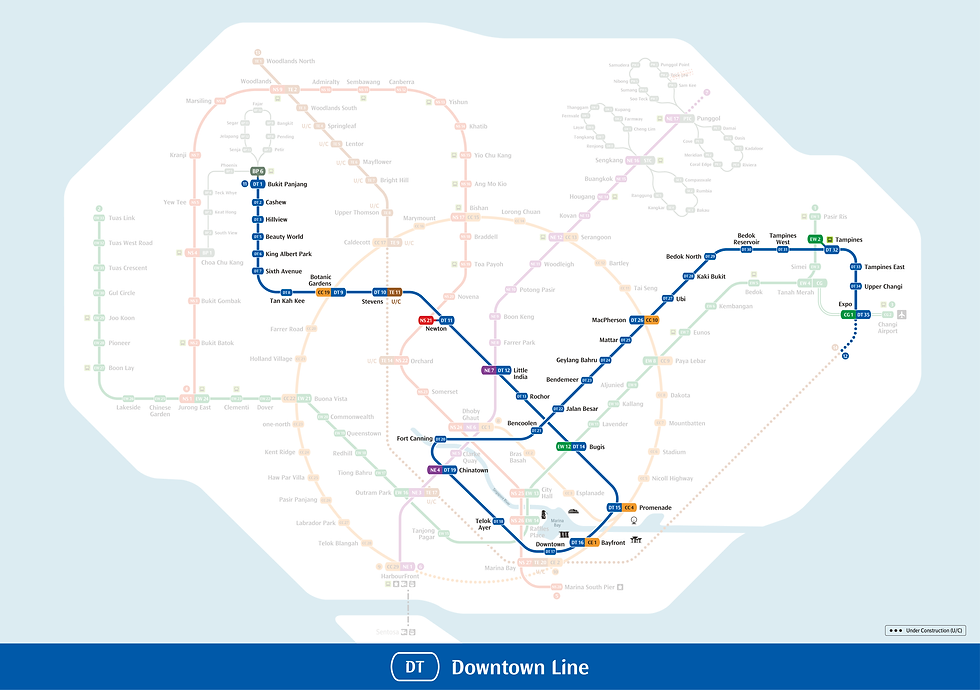
3. The future Downtown Line extension to Sungei Kadut is similar to what had been planned in 2001, except that 2001 suggested the extension be lengthened northward to Woodlands. I’ve always thought such an extension, covering the ageing neighbourhood of Marsiling and ending at Woodlands MRT Interchange, should be considered. It makes sense to complete the loop, so to speak, and the extension would greatly benefit people living and working in the north.

The junction of Admiralty Road and Marsiling Drive - part of Marsiling, the oldest part of Woodlands town. Credit: Google Maps.

4. It’s good that a planned LRT line for Jurong has been upsized to the Jurong Region Line, which also connects Choa Chu Kang and Bukit Batok. But considering the geographical vastness and size of the population of the Tuas-Jurong region, I still feel a new MRT line is needed to connect the whole area to the City, at least to relieve pressure on the ageing East West Line. I have also suggested this in Jalan Singapura.


5. 2001’s Bukit Timah Line was merged with the Eastern Region Line to create the present Downtown Line; the Thomson Line was merged with an East Coast line to get the present Thomson-East Coast Line. Merging planned lines is good - this reduces the number of transfers needed. Commuters generally prefer direct routes and fewer transfers.

The Downtown Line. Credit: Land Transport Authority.

6. It’s distressing to be reminded that the Circle Line of 2001 was subsequently rerouted to cover the Bukit Brown area. Future development of the entire historic region still remains very much on the cards.


7. I wonder if the planned reclamation of islands south of Marine Parade and East Coast Park would ever materialise. Sounds like an attractive notion, creating lots of land for seafront housing and recreation which could then free up space elsewhere, although I think the residents of Marine Parade and East Coast Road-Upper East Coast Road would violently object to having their coastline retreat from them!

Marine Parade Estate nearing completion in the 1970s. Credit: Housing and Development Board.


Today, four in five Singaporeans live in HDB flats. Dwelling in a flat is second nature. But it wasn’t always this way.

Credit: Mailer_Diablo, CC BY-SA 3.0.

I found a newspaper interview from 1984 (the year I was born!) shedding light on how kampung dwellers had to learn how to live all over again, after they were resettled to high-rise flats:

Madam Oh Kim Toh used to fear the elevator.


She said in Fujian: “You stand in there, and the door closes. What if it never opens again? Or worse, the lift may jam halfway. I may suffocate.”


A little diversion: This article came out in the 1980s, during the madness that was the Speak Mandarin Campaign which swept through Singapore. The mainstream media dutifully marched in step with the Government, renaming anything that had a “dialect” origin - Nee Soon to Yishun, Peck San to Bishan, Au Kang to Hougang, and so on. Here, Hokkien - the name of the language - was renamed “Fujian”. Mercifully, the Government halted this by the latter half of the decade, but some of the changes - like the place names I mentioned above - have persisted. This is covered in my book Jalan Singapura.


The 51-year-old housewife is also unused to other things, such as the flush toilet, as she had been going to a wooden hut over the fish pond during her kampung days.


The rubbish chute in her Yishun Ring Road flat is almost a miracle to her.


“We used to keep the garbage in a bin and take it to the backyard for burning. Now my children tell me to just dump it into this chute!”


For one born into rural life, at Lorong Buangkok, and who had spent more than 30 years in a wooden house, moving to a high-rise flat was, in many ways, relearning how to live.


Madam Oh had to learn how to use a lift, the flush toilet and the rubbish chute.


“My three children taught me things like pressing the right buttons in a lift to get to the floors I want,” she said.


My supervisor, who is in his late 40s, also told me that when he first used a lift as a child, he burst into tears because he was afraid of the claustrophobic space!


Even with encouragement and help from her family, Madam Oh took several months to settle down.


“I could not sleep because the flat was very warm compared with the kampung house. I still miss the open space and cool breezes after seven years.”


But Madam Oh definitely does not miss the floods, which could rise to chest height, the mosquitoes and the inconvenience of having to draw water from a well.


“I’m free too. There are no more pigs and poultry to look after.”


Expenses, however, have increased since they now have to pay PUB bills and services and conservancy charges on their three-room flat.


“But I guess that is the price you pay for comfort,” she said.


And now it is the current generation who has no idea how living in a kampung is like.


Copyright © 2025 Eisen Teo. Proudly created with Wix.com

bottom of page