top of page

Blog

Eisen Teo's blog has research and thoughts on history, transport, and urban studies,  and snippets of life experiences.
Search

Urban renewal is taking place in Shenton Way and Tanjong Pagar, so I headed to the city to check out the buildings being torn down or constructed. 


The iconic AXA Tower at 8 Shenton Way was completed in 1986, which makes it younger than me (!), but has been doomed to redevelopment.


At the junction of Shenton Way and Prince Edward Road.


Looking up at the junction of Shenton Way and Straits Boulevard.


The 52-storey skyscraper once housed the offices of the Ministry of Finance as The Treasury. 


It will make way for Skywaters Residences, a private residential complex which will become Singapore’s tallest building, at 63 storeys and 1,000 feet in height, when it is completed in 2028.


Tanjong Pagar is a short walk away from Shenton Way. In the area between Cantonment Road in the west and Anson Road in the east, there are no fewer than five construction sites. The air hangs heavy with clouds of dust and the cacophony of drilling and pounding. My heart goes out to the residents of nearby Tanjong Pagar Plaza, who will have to endure this for years, with little to no benefit to them.


Below is a map of the five construction sites, coloured blue.


Base map credit: Singapore Land Authority.

1. Keppel Towers at 10 Hoe Chiang Road, a 27-storey building launched in 1991, and Keppel Towers 2 at 240 Tanjong Pagar Road, formerly known as GE Tower, a 13-storey building completed in 1993, have been torn down for Keppel South Central, a 33-storey, energy-efficient commercial tower with a community plaza. Keppel South Central should be ready late next year.


A Straits Times report on the launch of Keppel Towers in August 1991. Credit: SPH Media Trust.

2. Tower Fifteen at 15 Hoe Chiang Road, formerly known as Euro-Asia Centre, at 29 storeys, has been demolished. Fragrance Group had applied to the Urban Redevelopment Authority (URA) for change of use for the site to full hotel usage, so a new hotel should rise on the spot. 


Tower Fifteen, sometime before 2003. Credit: Robert J Steiner.

3. Up to the 1980s, Bernam Street was nearly perpendicular to Anson Road. Between 1984 and 1986, it was realigned to run straight onto Lim Teck Kim Road. The realignment created an open field which laid fallow for more than three decades until recently, when work started on One Bernam, named after its address, 1 Bernam Street, a 34-storey luxury condominium tower to be completed by 2026.


Bernam Street in the 1984 street directory.
A realigned Bernam Street in the 1988 street directory.

4. Realty Centre, an 11-storey building at 15 Enggor Street first advertised in The Straits Times in 1970, was sold in 2019, and demolished after 2021. Its buyer The Place Holdings has obtained provisional permission from URA for a 37-storey mixed-use complex with a two-storey commercial podium and a 33-storey residential tower.


Realty Centre in July 2021.

5. Fuji Xerox Towers at 80 Anson Road, formerly known as IBM Towers, a 38-storey tower completed in 1987, is being demolished for Newport Plaza, a 47-storey mixed-use complex to be ready by 2027.


A Straits Times advertisement for IBM Towers as it neared completion in June 1986. Credit: SPH Media Trust.

Fuji Xerox Towers in July 2021.

The best view of the Tanjong Pagar construction sites is from the top floor of Block 1 Tanjong Pagar Plaza, as the common corridors open up to the south.


This is the southwest view of the sites for Keppel South Central and 15 Hoe Chiang Road.


This is the southeast view of the sites for One Bernam and 15 Enggor Street, and towering above them, Fuji Xerox Towers being torn down. The foreground will gradually rise while the background will slowly disappear.


I will be back in a year’s time.


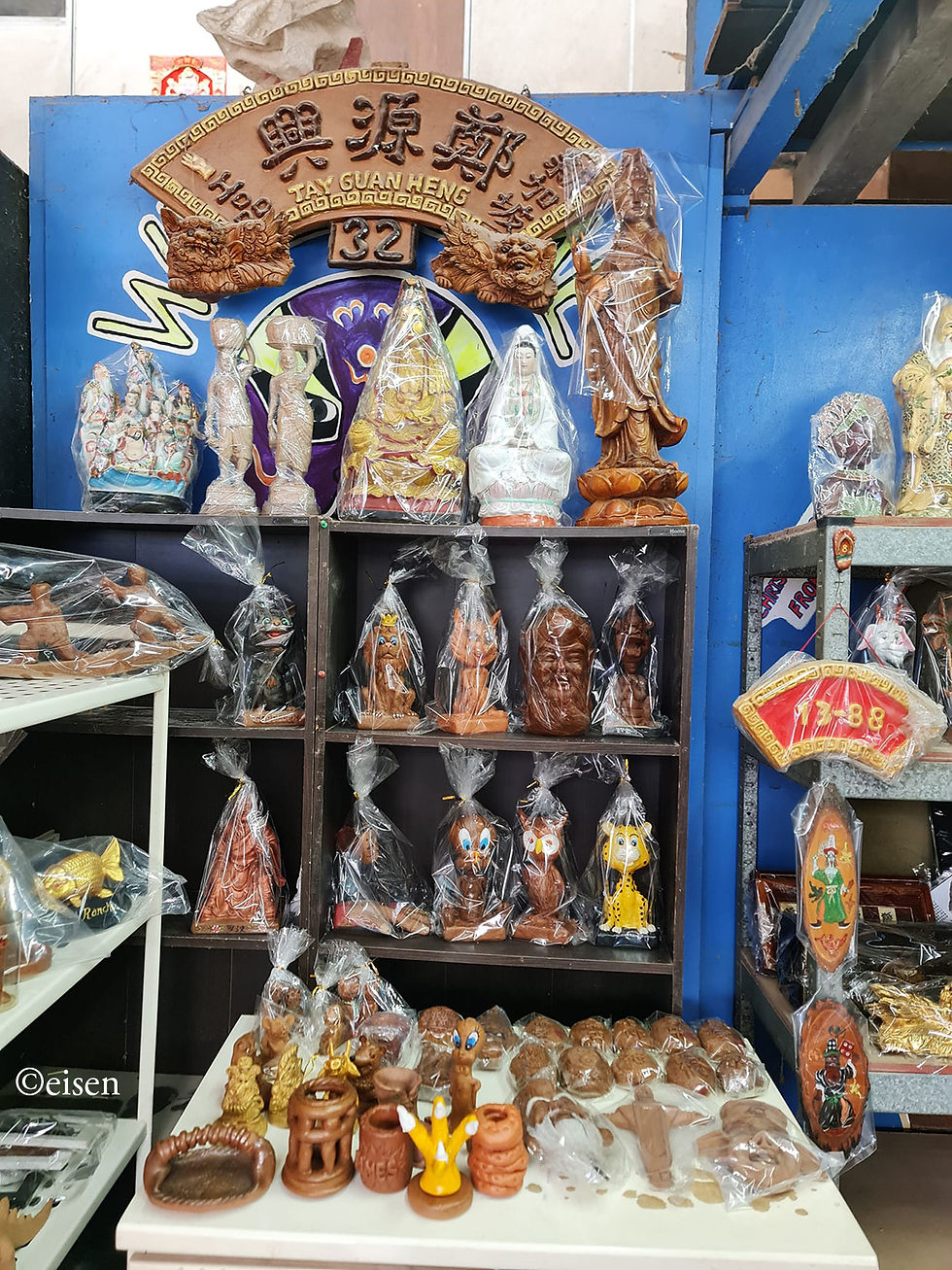
Paid a visit to Tay Guan Heng Joss-Sticks Manufacturer at 4001 Ang Mo Kio Industrial Park 1. I had seen online posts about its impending closure, so I wanted to see the place for myself before it was too late.


The humble factory space houses a dying trade that has endured four generations. The family business was founded in the 1930s, and specialised in giant, traditional joss sticks made of cinnamon wood clay, burned during Chinese festivals such as the 7th Lunar Month.


Like the paper offering industry, this business produces intricate, but transient, works of art that last only as long as the festivals for which they are dedicated.


During my visit, I was fortunate to meet the proprietor, Mr Albert Tay. He readily shared about his work, showing me old photo albums of the business’ glory days, and clay sculptures and dioramas on display on shelves.


The business will close at the end of November. Why, I asked. “A lot of pressure… a lot of stress”, Mr Tay shook his head sadly.


Until then, work carries on in the factory, to fulfil final orders.


Tay Guan Heng is open Mondays to Saturdays, 11am to around 4pm or 5pm. It is closed on Sundays.


Some time back, I took a closer look at an unusual overhead bridge along Serangoon Road.


Here’s another one - the Lorong Chuan Overhead Bridge.

At least, that’s what it’s called on Google Maps and on Wikipedia.


However, its name is a misnomer, because it is actually over Ang Mo Kio Avenue 1; the junction with Lorong Chuan is a short walk away. Perhaps it was given that name because it is near Lorong Chuan MRT Station, so people associate the surrounding area with the place name “Lorong Chuan”. Actually, Lorong Chuan is a fairly long road, running from Braddell Road in the south to Serangoon Garden Way in the north.


I would have called it the Mei Hwan Overhead Bridge instead, because it connects the Mei Hwan Drive Playground in the south to Li Hwan Close in the north.

Base picture credit: Google Maps.

Anyway, this overhead bridge is unique because it looks like it belongs to another era.


The overhead bridge resembles an elongated, olive green shipping container, with rows of octagonal windows on both sides. One might mistake it for a temporary structure, or an overhead bridge under construction.

But, it is the finished product - and it has been there for decades.


I am unsure when exactly it was completed. I saw online articles claiming that it was built in 1975. However, I could not find a primary source, be it in the newspaper archives or the National Archives, backing up the claim.


Street directories were not much help either, as overhead bridges appeared in them only between 1984 and 1988.

Since overhead bridges serve roads, I turned to the history of the roads surrounding the overhead bridge. Below is the area in 1970. At the time, Lorong Chuan (blue) was the only major road in the area, running by a steep hill. To its north, on the hill, was Jalan Pacheli (blue), at the southern edge of Serangoon Garden Estate.

Base picture credit: Singapore Land Authority collection, courtesy of National Archives of Singapore.

Below is the area in 1976. By then, two private housing estates had been built on either side of Jalan Pacheli - Tai Hwan Garden to the west, and Golden Hill Estate to the east, served by roads such as Tai Hwan Heights and Li Hwan Close (all pink). Ang Mo Kio Avenue 1 was still not on the map.

Base picture credit: Singapore Land Authority collection, courtesy of National Archives of Singapore.

This Straits Times Forum letter was published on 2 August 1977.

Credit: SPH Media Trust.

It starts with: “Ever since Ang Mo Kio Avenue 1 was opened, the traffic at Lorong Chuan has increased tremendously…” This means Ang Mo Kio Avenue 1 was completed sometime between 1976 and August 1977, to serve the up-and-coming Ang Mo Kio New Town.


As the road had to be completed first before the overhead bridge, my guess is that the Lorong Chuan Overhead Bridge was completed over Ang Mo Kio Avenue 1 sometime after August 1977 - which makes it up to 45 years old.


As Lorong Chuan ran alongside a steep hill, a cutting was made into the hill to construct Ang Mo Kio Avenue 1. Hence, the Lorong Chuan Overhead Bridge stands out again because the road it crosses is below the level of the general terrain, while the overhead bridge is around the level of the general terrain.

This is clear when one is right next to the overhead bridge.


This is the approach from the south, the Mei Hwan Drive Playground.

Inside the overhead bridge.


The approach from the north, Li Hwan Close. There are private homes on either side.

As the overhead bridge is needed to connect two private housing estates, my hope is that it will remain untouched for a long time.

 
bottom of page