top of page

Blog

Blog Picture.jpg
Search

Yesterday, I explored the ring of three public roads and two closed roads that surround the vast, open field that I dub the Old Holland Plain. The plain lies to the south of Methodist Girls’ School and King Albert Park MRT Station.


The public roads are Old Holland Road to the north, Holland Link to the east, and Holland Plain to the south. The closed roads are Holland Road South and Holland Road West. Together, they surround a sprawling patch of quiet, open greenery a short walk from the busy Bukit Timah-Dunearn trunk road.

Base picture credit: Google Maps.

Old Holland Road was derived from Holland Road. I’ve written about the latter as a secondary trunk road in Jalan Singapura. Holland Road wasn’t named after the geographical region in the Netherlands; rather, it was named after a person, probably Sir Henry Holland (1825-1914), Secretary of State for the Colonies from 1887 to 1892.

Sir Henry Holland in 1906.

Back when anything west of Orchard Road was considered “the country”, Holland Road served the suburban, northwestern part of the Municipality of Singapore. After a realignment sometime between the 1870s and 1880s, Holland Road connected Napier Road and Bukit Timah Road, running northwest for much of the way, then northeast, for a total of four and a half miles.


Holland Road in 1954, shaded blue:

The area I explored was the northern section of Holland Road in 1954, close to Bukit Timah Road. The Chinese cemetery at the 7th Milestone of Holland Road was Fong Yun Thai Cemetery, a Hakka graveyard.


The northern section of Holland Road in 1975:

Smaller tracks branching off the road, such as Yoon Kim Road, Lorong Makam, and Lorong Panchar, had been named.


The same area in 1995:

Methodist Girls’ School had moved to the area from Mount Sophia. Fong Yun Thai Cemetery had been exhumed; the remains of its deceased had been moved to a columbarium built by the association which had managed the cemetery.


The aforementioned tracks of Yoon Kim Road and Lorong Makam had been expunged; the latter for Holland Lane.


The area in 2007:

A new road system was forming - Holland Road North, Holland Road West, Holland Road South (absorbing Holland Lane), and Holland Link to create a ring road connecting Holland Road to Blackmore Drive. The stretch of Holland Road east of Brizay Park to Bukit Timah Road had been renamed Old Holland Road.


And the area today:

Base picture credit: Google Maps.

The area remains largely undeveloped. Part of Holland Road has been expunged. Holland Road West and half of Holland Road South remain closed; the other half of Holland Road South is now Holland Plain. Holland Road North has been renamed and added to Old Holland Road; this means the western part of Old Holland Road today is ironically, not so “old” - it is about 20 odd years old.


I started my journey in the south, where Holland Road South, Holland Road, and Holland Plain met.

People parked their cars here to play with their drones. I wonder whether they knew this wide expanse was once a Hakka cemetery. I tried imagining a sea of graves before me.

Holland Road South, closed to motor traffic. One could walk in though. Joggers used it too.

I walked on Holland Road South, heading west.

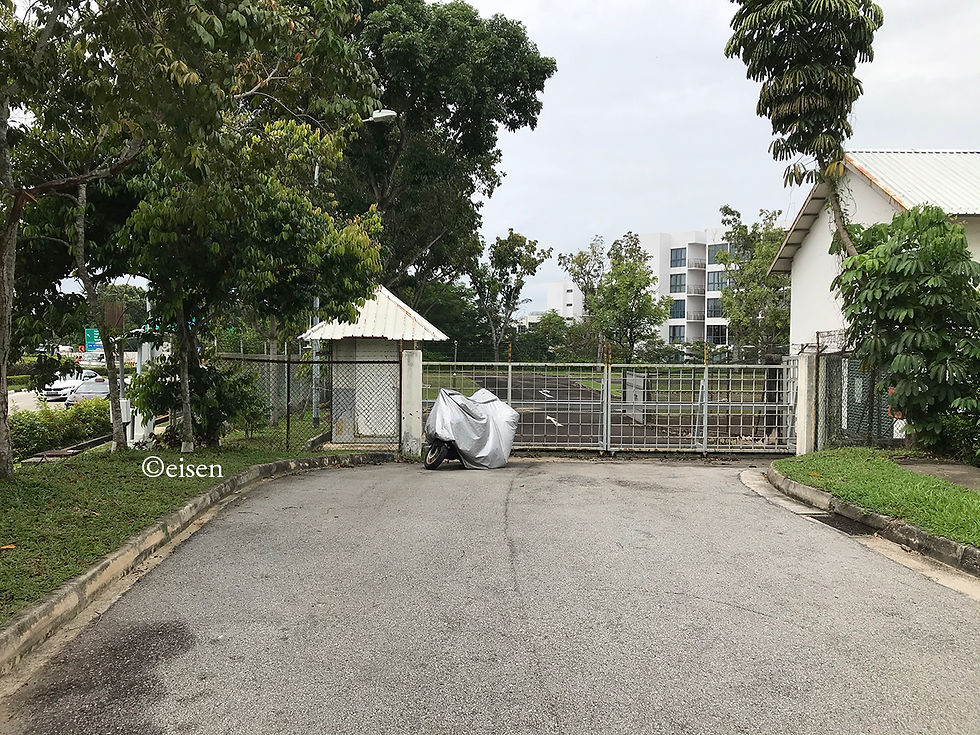
As Holland Road South gave way to Holland Road West, the road narrowed significantly, partly because years of neglect had allowed trees and bush to reclaim part of the road. Observing how nature encroached upon an abandoned road was fascinating.

Most of Holland Road West was split vertically 1:2 - one-third was left for pedestrians, joggers, and cyclists, while two-thirds was fenced off; a peek past the fence reveals a dusty track connected to work sites.

Holland Road West meets Old Holland Road and Blackmore Drive here.

This part of Old Holland Road used to be Holland Road North - not a very “old” road.

Old Holland Plain, formerly Fong Yun Thai Cemetery.

Holland Link.

The Fong Yun Thai Association Columbarium lies along Holland Link. More about the columbarium in a future post!

Holland Plain, formerly Holland Road South, and before that, Holland Lane, and further before that, Lorong Makam.

According to the Urban Redevelopment Authority’s 2019 Master Plan, Old Holland Plain is slated for housing. Laurel Wood Avenue will also be extended to connect Holland Link and Holland Plain to Sixth Avenue:

Credit: Urban Redevelopment Authority.

Like many open patches of greenery in Singapore, we’ll have to enjoy this while it lasts.


Spotted this advertisement in the Classified section of The Straits Times in 1979:

So many questions.


1. What was the “urgent matter”?


2. What happened between them, which led to the subject being uncontactable by phone or a visit?


42 years have passed. We’ll never know!

 
  • Jan 16, 2021

Singapore used to be covered by cemeteries. No thanks to urban renewal and redevelopment in a land-scarce, overcrowded city-state, most of these cemeteries have disappeared, but it’s fitting that we still have roads and places named after “Cemetery” in multiple languages.


For our national language Malay, there’s Jalan Kubor, or “Grave Road”, in Kampong Glam. The cemetery there predates the arrival of the British in 1819.

Jalan Kubor Cemetery, as seen from Victoria Street.

For Hokkien, there’s Tiong Bahru in the south. “Tiong” is Hokkien for “Cemetery”; “Bahru” is Malay for “New”. Numerous Chinese cemeteries there have been exhumed.


For English, many roads in Choa Chu Kang Cemetery - the only cemetery in Singapore currently open to burials - have “Cemetery” in them. For example, Christian Cemetery Path 11, Muslim Cemetery Path 4, and Hindu Cemetery Path 1.

Muslim Cemetery Path 4. Credit: Google Maps.

And as for Tamil, there’s Jalan Mayaanam, or “Graveyard Road”, a tiny road of around 140 metres, off Upper Changi Road North.

I recently visited Jalan Mayaanam. Heading down Upper Changi Road North, blink and you’ll miss it. It’s a narrow, single-lane dual carriageway, with hardly any lane markings. It seems to serve only two functions: An alternative exit for vehicles from the Salvation Army’s Peacehaven Nursing Home and the Japanese School, and free parking space for heavy vehicles. Next to the road is Exit 1 of the Tampines Expressway, which sees a continuous flow of traffic.

Jalan Mayaanam.
Free parking for heavy vehicles.
Plenty of erosion due to frequent parking.
Mature trees next to the road.
The end of the road just 140 metres in - locked gates of the Japanese School.

Jalan Mayaanam used to be far longer, running from the old Upper Changi Road to the now-defunct Tampines Road.

A 1976 map of the area. The fragment of Jalan Mayaanam still surviving today is marked in blue. Jalan Mayaanam's "Graveyard" refers to the Hindu cemetery in the middle of the map, now expunged. Base picture credit: Survey Department.

In the 1980s, the road was sliced in half by the northward extension of Upper Changi Road East to Tampines Road; the extension was later incorporated into Tampines Expressway.


Most of the rest of the road was subsequently expunged, saved for the fragment which still exists today.


If the expressway had been planned several metres to the right, Jalan Mayaanam would not exist today.

Credit: Streetdirectory.com.

The road got its name from the Hindu cemetery which used to exist to its east.


In 1982, The Straits Times described the cemetery as thus:


All the bodies, except for a few, are buried along one edge of the cemetery. There is an open hut 7 metres by 5 metres next to the entrance where the rituals before a burial take place.


There are two large 60-year-old trees, giving shade, ostensibly. They stand like sentinels, whispering to each other when the wind blows. A coconut tree, with its top sliced off by lightning, stands like an accusing finger. The white frangipani adds an unearthly fragrance to the atmosphere - an atmosphere of timelessness, for time has stopped for those who are here. The other half of the cemetery is a wide, open space of green grass, which gently dips towards one length of the boundary. From this half, the view is enchanting: a creamy blue sky forming a canopy over the luxurious green tops of trees.


The visitors come here to worship and worry. It is here that they feel hope and fear, grief and guilt, love and loath, all at once. It is simple yet stark; serene and yet uneasy. It is the place of eternal sleep. It is The Destination.

The cemetery. Credit: Singapore Press Holdings.

Sadly, by the 1990s, the cemetery was exhumed; condominiums stand on the site today. As for Graveyard Road, it is largely forgotten, known only to the drivers of heavy vehicles who wish for free parking.


Copyright © 2025 Eisen Teo. Proudly created with Wix.com

bottom of page